St Paul's Cathedral

St Paul's Cathedral

Why visit

Who will love it

Prioritize St Paul's if you appreciate architectural grandeur and want a panoramic view of London that feels earned. Climbing the 528 steps to the Golden Gallery offers a perspective of the City and the Thames that modern skyscrapers cannot replicate.

It is essential for those interested in British history, as the crypt holds the tombs of national icons like Nelson and Wellington.

Who should skip it

Skip the interior if you are on a tight budget or have limited mobility, as the high entry fee is primarily justified by access to the dome galleries. If you only want to see the famous facade or attend a short service without a full tour, you can experience the atmosphere for free during Evensong.

For most travelers, the decision rests on whether you are willing to pay for the climb; if not, a walk around the exterior is sufficient.

What to know beforehand

St Paul’s Cathedral is a rewarding stop for those who appreciate English Baroque architecture and have the stamina to climb the 528 steps to the Golden Gallery.

However, the £25 entry fee is steep if you only want a quick panoramic view of London, especially since modern viewing platforms nearby offer higher vistas for free.

The cathedral is best suited for visitors who want to take their time exploring the crypt, the nave, and the historical exhibits rather than just checking off a viewpoint.

Keep in mind that the climb to the top galleries involves narrow, spiral stone staircases that can feel claustrophobic during peak hours. If you have mobility limitations, your visit will be restricted to the cathedral floor and the crypt, making the ticket price harder to justify.

Insider Tip: Sightseeing is not permitted on Sundays, as the cathedral is reserved entirely for worship. If you want to experience the space and its acoustics for free, attend the Choral Evensong service in the late afternoon, though this does not include access to the dome climb or the crypt.

🎫 Tickets, tours & discounts

The standard sightseeing ticket is the most practical choice for almost every visitor. It provides full access to the Cathedral floor, the crypt where heroes like Nelson and Wellington are buried, and the three galleries of the dome.

Buying your ticket online in advance is the most effective way to save money, as walk-up prices at the entrance are consistently higher.

  • Standard Entry: Best for first-time visitors; includes the dome climb and a multimedia guide.
  • Triforium Tour: A specialized add-on for those who want to see the library, the Great Model, and the view from the internal balcony.

The most common mistake is arriving late in the afternoon and realizing the stairs to the dome galleries close significantly earlier than the main cathedral floor. To see everything, ensure you arrive at least two hours before the final entry time.

The best time to enter is right at opening, typically 8:30 AM on most days (10:00 AM on Wednesdays). This allows you to climb the dome before the narrow spiral staircases become crowded with tour groups. Midday is the busiest period, especially on Saturdays when queues for the Whispering Gallery can be long.

For a quieter experience, visit on a weekday morning. If you are a photographer, the Golden Gallery at the very top of the dome offers the best light shortly after opening. Note that on Sundays, the cathedral is open for worship only; sightseeing, dome climbing, and crypt access are not permitted.

St Paul's Cathedral is a major inclusion in the London Pass and the Go City Explorer Pass. If you plan to visit the Tower of London or Westminster Abbey on the same trip, using one of these passes is significantly cheaper than buying individual tickets.

Families should always opt for the dedicated family tickets (available for one or two adults with up to three children), which offer a better rate than individual admissions.

Additionally, if you pay the standard admission price and choose to treat it as a donation, you can often convert your ticket into an Annual Pass at the information desk, allowing free return visits for a full year.

The multimedia guide included with the standard ticket is excellent and sufficient for most visitors, offering deep dives into the architecture and history at your own pace. You should only book a guided tour if you have a specific interest in the 'hidden' areas of the cathedral.

The guided Triforium Tour is the only way to see the library and the geometric staircase, making it a must for architecture buffs but unnecessary for a general visit.

TipIf you are on a tight budget and only wish to see the interior architecture without climbing the dome or visiting the crypt, you can attend Evensong for free in the late afternoon. You will not be able to explore the building, but you can experience the space and the choir music as a worshipper.
Weather now
London, United Kingdom
NowMostly clear 🌤️
Temperature25°C
VisibilityExcellent
AerosolsClean air · AOD 0.10

Good conditions for visiting today.

AOD — how much dust and haze in the air dim the distant view. 0 clean, >0.4 noticeable, >0.7 heavy.

Crowd indicator

Midday and Saturdays see the heaviest crowds, while early mornings and weekdays offer a quieter experience for climbing the dome.

When to go?

Mini-calculator based on crowd levels by day and time.

Best time at Mon — 18:00

This day has average visitor density. This slot has a higher chance of a comfortable visit: Closed to visitors.

30–50% · Quiet60–80% · Moderate90–100% · Crowded

Nearest days

TodayLate opening today concentrates morning arrivals; expect a busy midday.
10:0075%
12:0090%
14:0080%
16:0050%
17:0040%
18:000%
TomorrowA standard weekday with manageable crowds if you arrive early.
10:0040%
12:0075%
14:0065%
16:0045%
17:0035%
18:000%
Day after tomorrowCrowds increase slightly ahead of the weekend; midday will be busy.
10:0050%
12:0085%
14:0075%
16:0050%
17:0040%
18:000%

How to find the entrance

1
St Paul's StationExit the Underground and walk south toward the cathedral dome.
2
West Front StepsApproach the main facade from Ludgate Hill and climb the stone stairs.
3
North West EntrancePass through the mandatory bag security check at the visitor door.
4
Internal Welcome DeskScan your digital ticket or pay at the kiosks inside the nave.

Address: St Paul's Churchyard, London EC4M 8AD Nearest metro: St. Paul's (Central line) District: City of London Summary: Sir Christopher Wren's masterpiece, featuring an iconic dome, historic crypts, and panoramic galleries overlooking the London skyline.

Core context: Visitors enter through the West Front, where they must pass through a security bag check. A strict bag size limit is enforced, and there are no storage facilities on-site. Climbing to the dome galleries requires physical exertion across hundreds of steps.

Entrance Instructions:

When arriving at the cathedral, head directly to the West Front, which serves as the main entrance for sightseeing. If you already have a digital or printed ticket, proceed straight to the security screening line.

If you need to purchase tickets on the day, you must join the ticketing queue located just inside the West Front before proceeding to the entry point.

The primary source of delay is the mandatory security screening. Queues build up on the steps outside during midday. You can speed up your entry by having your bags open and your tickets ready for scanning immediately after the security check.

If you require step-free access, bypass the main West Front steps and use the ramped entrance located at the North Transept.

Keep the following entry rules in mind to avoid being turned away:

  • All bags are subject to mandatory security screening at the entrance.
  • A strict bag size limit of 45cm x 30cm x 25cm is enforced; larger suitcases or rucksacks will be refused entry.
  • The climb to the upper dome galleries involves 528 steps and requires significant physical exertion.
ImportantThere are no cloakrooms or luggage storage facilities inside the cathedral. You must carry all your belongings with you throughout your visit, so ensure you leave large bags at a nearby storage provider before arriving.

Practical limits & what to bring

What to consider before your visit

Expect a security screening at the entrance, which can cause short delays during peak morning hours. While the Cathedral floor and Crypt are fully accessible via the South Churchyard entrance and internal lifts, the ascent to the Dome is a significant physical challenge.

Reaching the Golden Gallery requires climbing 528 narrow steps; there is no lift access to the upper levels, and the climb is not suitable for those with mobility issues or vertigo.

As St Paul’s is an active place of worship, visitors should dress respectfully. Men are asked to remove hats, and quiet is expected during services. Photography for personal use is permitted during sightseeing hours, but it is strictly prohibited during all church services and in the Whispering Gallery.

What is allowed and what is forbidden

  • No bags larger than 45cm x 30cm x 25cm including handles and wheels.
  • No professional cameras, recording equipment, tripods, or selfie sticks.
  • No food or alcoholic drinks; only clear bottled water is permitted inside.
  • No sharp items, pocket knives, or tools.
  • Small personal bags and backpacks are allowed subject to search.

Storage and belongings

There are no cloakrooms or luggage storage facilities inside the Cathedral. Any items exceeding the size limit of 45cm x 30cm x 25cm will be denied entry, and you will need to use private luggage lockers at nearby transport hubs like Blackfriars or Liverpool Street stations.

Strollers and prams are permitted on the Cathedral floor and in the Crypt, with lift access available between these levels. However, strollers cannot be taken up the stairs to the Dome galleries and must be left at the designated buggy park near the entrance. Please note that this storage area is unattended.

TipBook your tickets online to secure a lower rate of £25 for adults, as walk-up prices at the gate are higher at £30.

Location and what's nearby

What the area is like

  • The City of London is the historic heart and global financial engine, blending ancient stone monuments with glass skyscrapers.
  • It follows a corporate rhythm, bustling with office workers on weekdays and becoming remarkably quiet and atmospheric on weekends.
  • The neighborhood is dense with hidden alleys, medieval church ruins, and high-end retail hubs like One New Change.
  • It is a prime location for history buffs and architecture enthusiasts who want to see the contrast between old and new London.

Nearby on foot (up to 15 minutes)

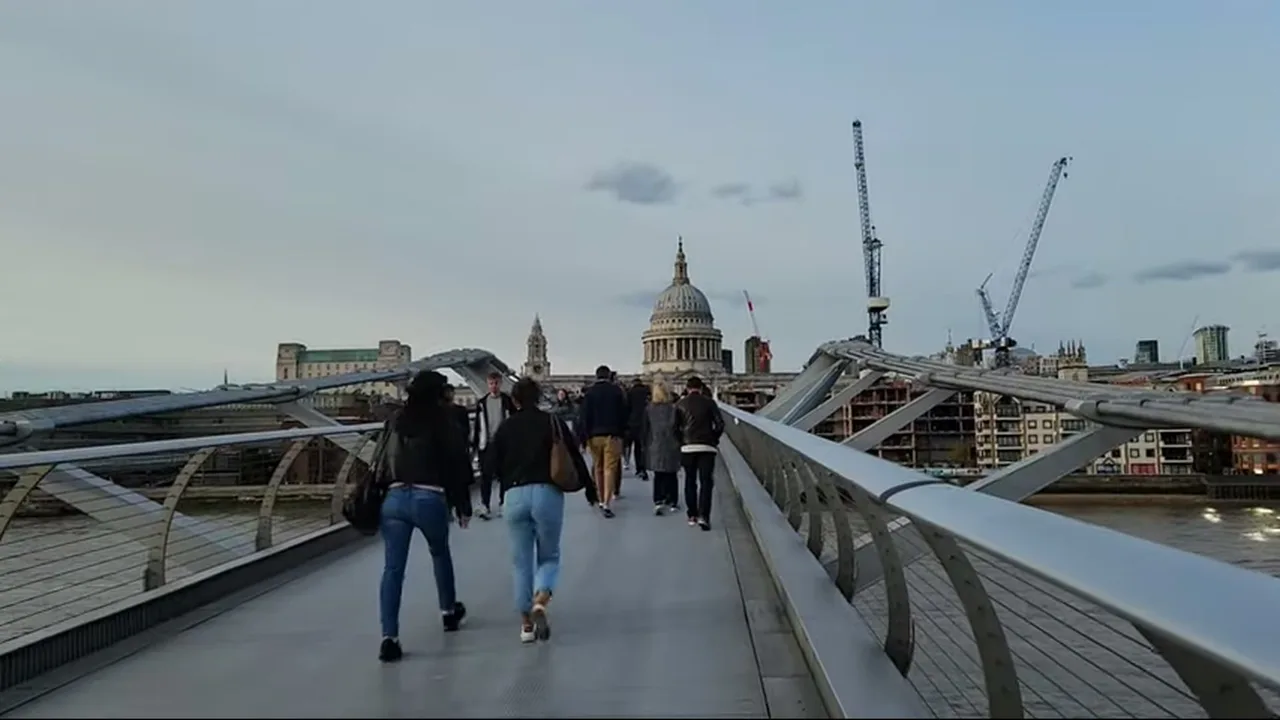
  • Millennium Bridge — iconic pedestrian steel suspension bridge offering the best views of the cathedral · 4 min
  • One New Change — shopping center with a free public roof terrace overlooking the dome · 2 min
  • Tate Modern — world-renowned contemporary art gallery housed in a former power station · 10 min
  • Paternoster Square — pedestrian plaza featuring the historic Temple Bar gate and modern sculptures · 1 min
  • Postman's Park — quiet garden housing the unique Memorial to Heroic Self-Sacrifice · 5 min
  • Guildhall — the administrative center of the City with a medieval Great Hall · 8 min
  • London Mithraeum — reconstructed Roman temple ruins located beneath the Bloomberg building · 7 min

15–30 minutes by transport

  • Tower of London — historic fortress and home to the Crown Jewels · 12 min by bus
  • Borough Market — London's most famous food market with diverse artisanal stalls · 15 min by bus
  • Sky Garden — high-altitude indoor garden with panoramic views of the skyline · 10 min by bus
  • Covent Garden — vibrant district known for street performers, markets, and theaters · 15 min by tube
  • Southbank Centre — cultural hub featuring the Royal Festival Hall and riverside book markets · 20 min by bus

Where to eat nearby

  • Madison — rooftop bar and grill with spectacular cathedral views · above average · booking essential · 2 min walk
  • Bread Street Kitchen — Gordon Ramsay's industrial-chic spot serving reliable British-European classics · above average · booking recommended · 3 min walk
  • Paternoster Chop House — traditional British meats and seafood in a modern setting · above average · booking recommended · 2 min walk
  • The Ivy Asia St Paul's — vibrant Asian fusion with maximalist decor and floor-to-ceiling windows · above average · booking essential · 2 min walk
  • Haz St Paul's — popular local spot for high-quality Mediterranean and Turkish grilled dishes · mid-range · booking recommended · 5 min walk

Ready-made itinerary for the day

Start your morning exploring the depths and heights of St Paul's Cathedral before heading to the roof terrace at One New Change for a different perspective of the dome.

Cross the Millennium Bridge at midday for a walk along the South Bank, stopping for lunch at Bread Street Kitchen or exploring the galleries at Tate Modern. End your day by walking east toward the Tower of London or enjoying sunset drinks at a nearby rooftop.

NoteVisit on a Sunday if you want to experience the City's quiet, cinematic atmosphere without the weekday crowds, though some local sandwich shops may be closed.
Reference

Facts

Read more

Figures and Scale

  • Height: 365 feet (111 meters) from the floor to the top of the cross, symbolizing one foot for every day of the year.
  • Dome Weight: 65,000 tons, supported by eight massive piers to distribute the immense pressure across the clay foundations.
  • Construction Timeline: 35 years were required to complete the structure between 1675 and 1710, a remarkably short period for a cathedral of this size.
  • Bell Weight: 16.5 tons for the Great Paul bell, making it the largest swinging bell in the United Kingdom.
  • Step Count: 528 steps lead visitors from the cathedral floor to the Golden Gallery, offering the highest outdoor vantage point in the City of London.
  • Total Length: 518 feet (158 meters), creating a vast nave designed to accommodate massive state processions and national ceremonies.

Myths and Misconceptions

  • Myth: St Paul's is the original church built on this specific hilltop. In reality: This is the fifth cathedral on the site; the previous Gothic version burned in 1666.
  • Myth: The massive outer dome is a single, solid stone shell. In reality: It is a triple-shell structure with a hidden brick cone supporting the 850-ton stone lantern.
  • Myth: The Whispering Gallery uses hidden pipes or wires to carry sound. In reality: The effect is purely acoustic, where sound waves hug the perfectly circular wall.
  • Myth: Sir Christopher Wren is buried in a massive, ornate gold monument. In reality: He has a simple black marble slab in the crypt with a famous Latin inscription.

Rare and Unusual

  • The Geometric Staircase: This floating stone spiral was used as the staircase to the Divination classroom in the Harry Potter film series.
  • The Great Model: A 20-foot long wooden model of Wren's rejected Great Model design is stored inside, showing a vastly different vision for the church.
  • The Blitz Survival: During WWII, a volunteer group called the St Paul's Watch lived in the cathedral to manually extinguish incendiary bombs landing on the roof.
  • Hidden Library: The triforium level contains a library of 20,000 volumes, including rare medieval manuscripts that survived the Great Fire of London.
  • Crypt Ventilation: Small decorative brass grilles in the floor are not just for air; they were designed to allow light to filter into the vast underground crypt.
Background

History

Read more

St Paul's Cathedral stands as the defining symbol of London's resilience. Following the Great Fire of 1666, which destroyed the original medieval structure, Sir Christopher Wren was commissioned to design a replacement that would signal the city's recovery.

The resulting Baroque masterpiece, with its iconic dome, remained the tallest building in London for nearly three centuries.

A National Landmark

The cathedral serves as a stage for Britain's most significant historical moments, from the funerals of Lord Nelson and Winston Churchill to royal weddings. During World War II, the image of the dome standing firm amidst the smoke of the Blitz became a powerful icon of survival, cementing its place as a spiritual and cultural anchor for the capital.

For today’s visitor, the site offers a direct connection to London’s architectural evolution. Exploring the vast crypt—the largest in Europe—and climbing to the Stone and Golden Galleries provides a perspective on how Wren’s vision still dominates the modern skyline.

The intricate mosaics and the unique acoustics of the Whispering Gallery remain as impressive now as they were centuries ago.

♿ Accessibility & families

Step-free access is available to the Cathedral Floor and Crypt via the North Transept ramp and internal lifts. The upper Dome galleries are accessible only by stairs.

Excellent for families with free entry for children under 6 and dedicated multimedia guides for kids.

Accessibility and Mobility

St Paul’s Cathedral is accessible to wheelchair users and visitors with reduced mobility through the North Transept entrance, which features a permanent ramp. Once inside, a modern lift provides access between the Cathedral Floor and the Crypt.

While the main areas of worship and history are fully accessible, the historic nature of the building means the Whispering Gallery, Stone Gallery, and Golden Gallery are only reachable via steep, narrow spiral stairs.

These upper levels are not suitable for wheelchair users or those with significant mobility limitations.

Families and Strollers

Pushchairs and strollers are permitted on the Cathedral Floor and in the Crypt. You can move between these levels using the lift located in the North Transept. If you intend to climb the Dome, you must leave your stroller in the designated storage area at the entrance, as they are strictly prohibited on the stairs.

The climb to the top involves 528 steps; it is physically demanding and features narrow passages that may be difficult for very young children or parents carrying infants.

Age Requirements and Entry

Children under the age of 6 are granted free entry. All visitors under the age of 18 must be accompanied by an adult aged 18 or older to enter the Cathedral. For families, the multimedia guides included with entry offer a specific 'family tour' designed to engage children with interactive stories and games about the building's history.

Comfort and Constraints

The Cathedral is a place of active worship, so families are encouraged to maintain a level of quiet during services. For those with sensory sensitivities, the Crypt can be cooler and quieter than the main floor.

Be mindful that the final ascent to the Golden Gallery is outdoors and exposed to the elements, which may be challenging for children during windy or wet weather.

🏢 On-site amenities

Public restrooms, including accessible stalls and baby-changing stations, are located in the Crypt. These facilities are free for all visitors with a valid entry ticket.

The Crypt Cafe offers a casual dining environment with a variety of sandwiches, cakes, and hot beverages. Drinking water fountains are available on-site, and visitors are welcome to bring their own water in non-glass containers.

A large gift shop in the Crypt stocks a range of items from guidebooks and religious icons to bespoke London souvenirs. A smaller shop is also located near the cathedral exit.

Free Wi-Fi is accessible to all guests throughout the building. For those seeking a quiet space, side chapels such as St Dunstan’s are reserved specifically for prayer and reflection.

Reliability & freshness

UpdatedJune 20, 2026

I live in London and, after seven years here, I write clear guides on transport, costs, neighbourhoods and day trips.