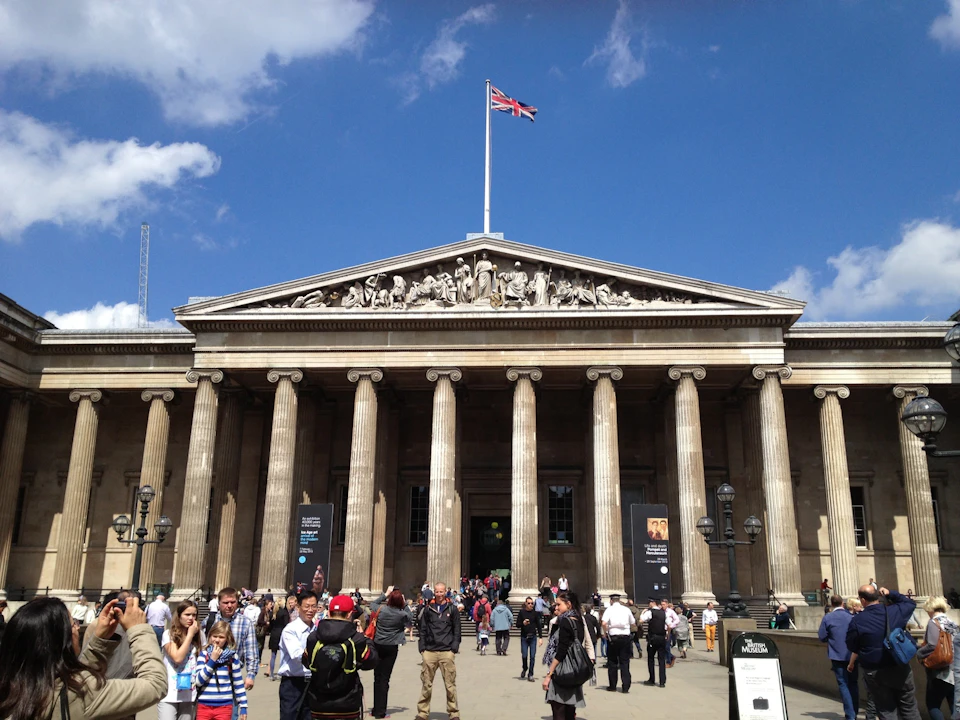
History enthusiasts and first-time visitors should prioritize this museum to see world-defining artifacts like the Rosetta Stone and the Parthenon Sculptures. It is the essential choice for those who want to trace the timeline of human civilization across two million years within a single, architecturally stunning landmark.
The British Museum

Why visit
Skip this if you are easily overwhelmed by massive crowds or prefer a more focused, intimate gallery experience. The scale of the collection is exhausting for a quick visit, so those with limited time or a preference for contemporary culture should consider the Tate Modern or the nearby Sir John Soane’s Museum instead.
What to know beforehand
A monumental treasury of world history that demands a strategic approach to navigate its vast scale and dense crowds.
The British Museum is best experienced through targeted visits rather than a single marathon. While the Great Court is an architectural marvel, the most famous galleries—particularly those housing the Egyptian mummies and the Parthenon Sculptures—become intensely congested by mid-morning.
Arriving for the first entry slot is the only reliable way to view the Rosetta Stone without significant obstruction.
History enthusiasts will find the depth of the collection unparalleled, but those who prefer interactive, tech-driven exhibits or a quiet, contemplative atmosphere may find the constant bustle and school groups draining.
For a more relaxed pace, head to the upper floors to explore the Sutton Hoo hoard or the Japanese galleries, which see far fewer visitors than the ground-floor highlights.
Expert Insight: Focus on one civilization per visit to avoid museum fatigue and use the cloakroom near the main entrance to stay mobile.
Weekday mornings for the 10:00 opening to stay ahead of the peak afternoon rush.
Admission is free, though booking a timed entry slot is mandatory for all visitors. A suggested donation of £5 is welcomed at the entrance.
Allocate 3 to 4 hours for a highlights tour, or a full day if you intend to explore the upper-level galleries in detail.

🎫 Tickets, tours & discounts
General Admission (Timed Entry)
- Access to permanent galleries
- Timed entry slot
- Great Court access
- Rosetta Stone viewing
Special Exhibition Ticket (Temporary Exhibition)
- Entry to current temporary exhibition
- Timed entry slot
- Access to permanent collection
- Digital exhibition guide
Highlights Guided Tour (British Museum Official Tour)
- 90-minute expert-led tour
- Headset for clear audio
- Key artifacts historical context
- Permanent collection access
Private Guided Tour (Expert Historian)
- 2.5-hour private guide
- Customizable itinerary
- Deep dive into world history
- Skip-the-line group entry
The British Museum
London
GBP
Which ticket to choose
Entry to the permanent collection is free, but you must book a timed entry slot in advance. This basic ticket grants access to the museum's most famous treasures, including the Rosetta Stone, the Elgin Marbles, and the Egyptian mummies.
Paid tickets are only required for temporary special exhibitions, which typically cost between £15 and £25 depending on the subject.
For a first-time visitor, the free entry ticket is more than enough to fill an entire day. Paying for a special exhibition only makes sense if you have a specific interest in the rotating themes, such as Silk Roads or ancient luxury.
The most frequent mistake travelers make is assuming that 'free' means 'walk-in.' Without a pre-booked digital slot, you risk being turned away at the gate, especially during peak hours.
Best time to visit
The most peaceful experience is found on weekday mornings, specifically Tuesday or Wednesday, arriving right at the 10:00 opening. Alternatively, the museum offers late-night opening on Fridays until 20:30.
This evening slot is the best choice for adults and couples, as the crowds thin out significantly and the atmosphere in the Great Court is much more atmospheric.
Avoid weekend afternoons and school holiday periods, as the galleries become congested and noisy. For those focused on photography, the morning light under the glass roof of the Great Court is ideal, but for a quiet walk through the Greek and Roman galleries, the Friday evening window is unbeatable.
Combos and discounts
Since the main museum entry is free, traditional 'combo' tickets usually focus on guided tours. The London Pass and Go City Explorer Pass are excellent options that include a professional 2-hour guided highlights tour. This is a great way to ensure you see the most important artifacts without getting lost in the museum's 60+ galleries.
National Art Pass holders receive a 50% discount on special exhibition tickets, and some exhibitions are entirely free for members. Visitors under the age of 16 can enter paid exhibitions for free when accompanied by an adult. There are no specific discounts for London residents, as the core collection remains accessible to everyone at no cost.
When a tour makes sense
A guided tour is highly recommended for those who want to see the 'Top 10' artifacts in under two hours. The museum houses over 8 million objects, and navigating the layout can be confusing. An official 'Museum Highlights' tour costs £14 and provides essential historical context that brings the stone and bronze objects to life.
If you prefer to explore at your own pace or have a very specific interest, such as Japanese prints or clocks, a self-guided visit is better. You can rent an audio guide at the entrance for £5, which allows you to customize your route.
Families often find that a private, child-friendly tour is worth the investment to keep younger visitors engaged with the more dramatic Egyptian and Assyrian sections.

Crowd indicator
Crowds peak during weekend afternoons and summer holidays, while weekday mornings and Friday evenings offer the most peaceful viewing experience.
Mini-calculator based on crowd levels by day and time.
This day is usually noticeably busy. This slot has a higher chance of a comfortable visit: Best time to arrive for quiet galleries.
Nearest days

How to find the entrance
The primary entrance is located on Great Russell Street. Upon arrival, you will encounter two separate lines: one for visitors with pre-booked timed entry tickets and another for those without. To avoid long waits or potential denial of entry during busy periods, secure your free timed slot in advance.
Most of your time before entering will be spent in the security screening queue outside the main doors.
For a quieter experience, use the Montague Place entrance on the north side of the building. This entrance is often less crowded than the Great Russell Street gates and provides direct access to the northern galleries.
Once you pass security and enter the Great Court, the space opens up significantly, and you can proceed directly to the galleries or the information desk.
- Security bag checks are mandatory for all visitors and typically take 10 to 20 minutes.
- Timed entry tickets are scanned at the threshold of the Great Court.
- Step-free access is available via the elevators located to the left of the main stairs at the Great Russell Street entrance.

Practical limits & what to bring
What to consider before your visit
Entry requires a pre-booked timed slot, even though admission is free. Expect a mandatory security check at the gates, which can result in a 15–20 minute wait during peak hours. The museum covers a massive area with significant walking distances, so wear comfortable shoes and plan for at least three to four hours to see the main highlights.
While there is no formal dress code, the galleries can get crowded and warm, particularly in the Egyptian and Greek sections. Accessibility is excellent with lifts to all floors, though some secondary routes may require a short detour to reach the elevators.
What is and isn't allowed
- Forbidden: Wheeled luggage, large sports bags, and any item heavier than 8kg.
- Forbidden: Tripods, monopods, selfie sticks, and professional recording equipment.
- Forbidden: Sharp objects, tools, and liquids in open containers such as coffee cups.
- Allowed: Small handbags and daypacks, which should be worn on the front or carried by hand in busy areas to protect the exhibits.
- Allowed: Personal photography without flash or a tripod.
- Allowed: Bottled water with a secure screw-cap.
Storage and belongings
The cloakroom is located in the Great Court and operates on a paid basis. Current rates are £2 for coats or umbrellas and £5 for bags. All items must pass a security scan and cannot exceed 40x40x50cm in size. Items heavier than 8kg will be refused.
Strollers and buggies are welcome inside the galleries, and there is a dedicated buggy park near the main cloakroom if you prefer to explore without one. Note that the museum does not have storage for large suitcases; you must use private luggage storage facilities at nearby transit hubs like Holborn or Euston stations.

Location and what's nearby
The Neighborhood
- Bloomsbury is London's intellectual and literary heart, characterized by its elegant Georgian architecture and quiet residential squares.
- The district is home to the University of London and numerous publishing houses, creating a studious and sophisticated atmosphere.
- It is an ideal area for a focused cultural day, offering a refined pace compared to the high-energy shopping districts nearby.
Nearby on foot (up to 15 minutes)
- Russell Square — Large historic park with a central fountain and a quiet garden cafe · 5 minutes
- The Cartoon Museum — Specialized gallery dedicated to British editorial cartoons and comic strip art · 10 minutes
- Sir John Soane's Museum — Remarkable historic house filled with antiquities and architectural curiosities · 12 minutes
- Store Street — Charming stretch of independent shops, bakeries, and architectural bookshops · 6 minutes
- Covent Garden — Vibrant district famous for its covered market, street performers, and boutiques · 14 minutes
- Lincoln's Inn Fields — The largest public square in London, surrounded by historic legal institutions · 12 minutes
15–30 minutes by transport
- Southbank Centre — Major riverside arts complex featuring theaters, galleries, and food markets · 20 minutes by tube
- Tate Modern — World-renowned contemporary art gallery located in a former power station · 25 minutes by bus
- St. Paul's Cathedral — Masterpiece of Baroque architecture with an iconic dome and whispering gallery · 15 minutes by tube
- Regent's Park — Expansive Royal park home to the Queen Mary's Rose Gardens · 25 minutes by tube
Where to eat nearby
- The Museum Tavern — Historic Victorian pub serving traditional British pies and cask ales · average · can visit without booking · 1 min walk
- Noble Rot Bloomsbury — Award-winning wine bar and restaurant focusing on seasonal European cuisine · above average · booking recommended · 8 min walk
- Ciao Bella — Lively and atmospheric Italian institution famous for its generous pasta dishes · average · booking recommended · 10 min walk
- Honey & Co. — Celebrated Middle Eastern deli and restaurant serving vibrant salads and cakes · average · booking recommended · 12 min walk
Ready-made itinerary for the day
Spend your morning exploring the vast historical collections of the British Museum before stopping for a traditional lunch at The Museum Tavern just across the street. In the afternoon, take a short walk to the eccentric Sir John Soane's Museum to see its unique architectural treasures.
Conclude your day with a stroll through the squares of Bloomsbury toward Covent Garden for dinner at Ciao Bella and an evening of street performances.

ReferenceFacts
Read more
Numbers and Scale
- Founded: 1753, making it the first national public museum in the world to cover all fields of human knowledge.
- Collection size: 8 million objects, representing the history of human culture from its beginnings to the present.
- Great Court: 2 acres in size, it remains the largest covered public square in Europe.
- Glass Roof: 3,312 individual glass panes held together by a steel frame weighing 478 tonnes.
- Rosetta Stone: 760 kilograms in weight, this slab provided the key to deciphering Ancient Egyptian hieroglyphs.
- Gallery space: 4 kilometers of walking distance if a visitor were to pass through every open room in the building.
Myths and Misconceptions
- Myth: The Rosetta Stone is a unique piece of ancient literature. Reality: It is a repetitive administrative decree issued by a council of priests to affirm the royal cult of Ptolemy V.
- Myth: The museum displays its entire vast collection to the public. Reality: Only about 1% of the 8 million items are on display, with the rest kept in climate-controlled storage.
- Myth: All Egyptian mummies in the collection were intentionally embalmed. Reality: Some, like the famous Gebelein Man, were naturally preserved by the dry heat of the desert sand.
Rare and Unusual
- The museum employs a specialized team of preventive conservators who use pheromone traps to protect ancient textiles from moths and beetles.
- A resident cat named Mike famously guarded the main entrance for 20 years and was so well-known he received a formal obituary in the press.
- The Reading Room at the center of the Great Court was a favorite haunt of Karl Marx, who wrote much of his work at desk number L13.
- Beneath the floor of the Great Court lies a sophisticated mechanical system that regulates the temperature of the massive open space without visible radiators.
- The Holy Thorn Reliquary contains a thorn believed in the Middle Ages to be from the crown of thorns worn by Jesus during the crucifixion.
BackgroundHistory
Read more
A museum for the curious
The British Museum was established in 1753 and opened its doors in 1759, making it the world's first national public museum. It began with the vast collection of Sir Hans Sloane, an eighteenth-century physician who bequeathed more than 70,000 objects to the nation.
From its inception, the museum was designed to be free and open to all visitors, a guiding principle that remains today.
As the British Empire expanded, the museum's holdings grew rapidly, acquiring landmark artifacts from across the globe, including the Rosetta Stone and the Parthenon Sculptures.
The collection eventually became so massive that its natural history specimens and library archives were spun off to create separate national institutions. This allowed the Bloomsbury site to focus entirely on the history of human culture.
Today, the museum houses millions of objects spanning two million years of history. For modern visitors, it serves as a unique crossroads where you can trace the interconnected stories of different world civilizations under one roof.
The experience is anchored by the Great Court, a striking glass-and-steel courtyard that seamlessly connects the historic galleries.

♿ Accessibility & families
Accessibility and Mobility
The British Museum is fully accessible for wheelchair users and visitors with reduced mobility. The main entrance on Great Russell Street features a self-operated lift located to the left of the stairs. Alternatively, the Montague Place entrance provides level access directly into the museum.
All floors and galleries are connected by a network of elevators, though some smaller lifts in the older wings may have a capacity limit for larger motorized scooters. Manual wheelchairs are available to borrow free of charge at the main entrance on a first-come, first-served basis.
Family and Stroller Policy
Strollers and prams are permitted in all galleries, and the museum’s open-plan layout in the Great Court makes it easy to navigate. Large elevators provide access between levels, ensuring parents do not need to carry equipment up stairs.
Baby changing facilities are conveniently located in the Great Court and on the lower floor near the Ford Centre for Young Visitors. Be aware that the Egyptian and Greek galleries on the ground floor can become extremely crowded and noisy; for a quieter break, head to the upper-level galleries or the North Stairs area.
Age Requirements and Entry
General admission to the permanent collection is free for everyone. For special ticketed exhibitions, children under 16 usually receive free entry but still require a booked ticket. All visitors under the age of 16 must be accompanied by an adult at all times.
There are no strict age limits for any galleries, but the vast scale of the building means families with children under 12 should plan for frequent rests in the Great Court seating areas.
🏢 On-site amenities
Free restrooms are located on every floor of the museum. The largest facilities, including accessible toilets and baby-changing stations, are situated on the lower ground floor of the Great Court and near the North Entrance.
The Great Court Restaurant on the upper level offers a refined seated experience with afternoon tea and hot entrees. For casual snacks, sandwiches, and coffee, the Court Cafe is located on the main floor of the Great Court, while the Montague Cafe provides additional seating near the front entrance.
The main museum shop in the Great Court features a vast selection of history books, jewelry, and replicas of famous artifacts like the Rosetta Stone. Smaller boutique shops are often found near temporary exhibition galleries. Free Wi-Fi is available to all visitors throughout the building.
Water fountains for refilling bottles are available near the main restrooms on the lower ground floor. While you can bring your own water in plastic bottles, food must be consumed within the designated cafe areas. A dedicated family room with nursing facilities is located on the lower floor of the Ford Centre for Young Visitors.